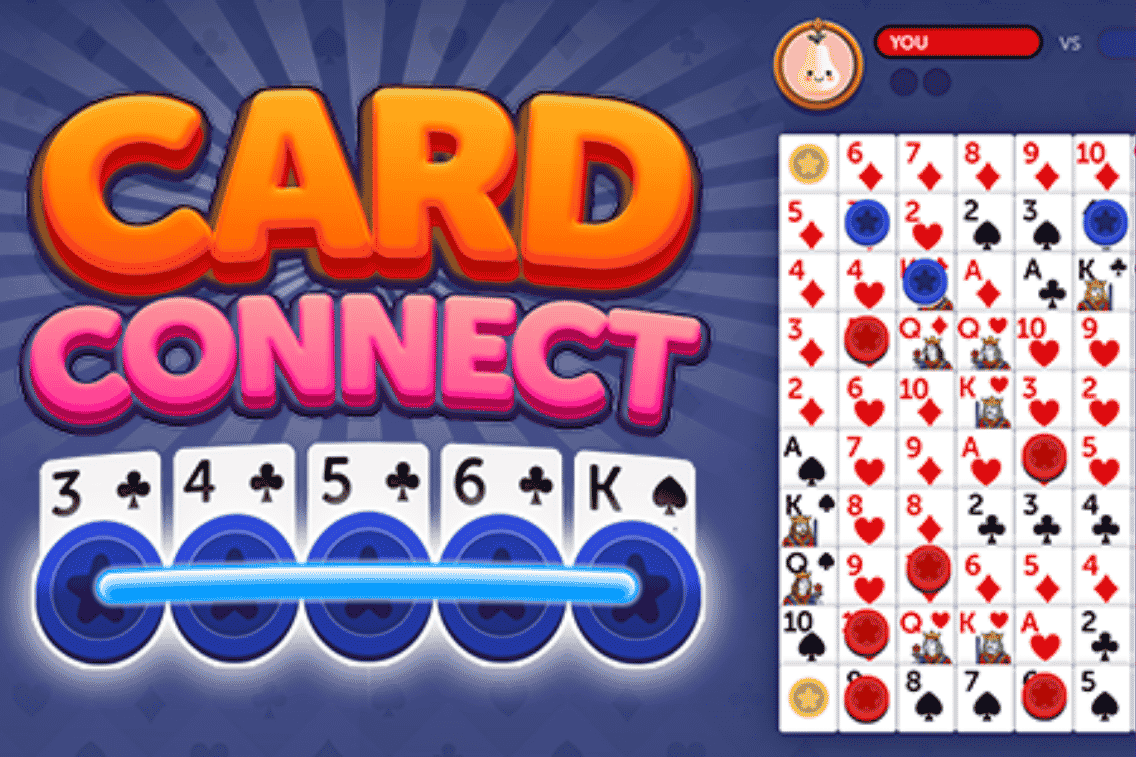

Card Connect: Make Sequences takes the classic board game Sequence and turns it into fast, head-to-head duels on your phone.
Learning how to play Card Connect takes one round: Play a card, claim a matching space and connect five chips in a row. But winning takes more. Knowing which space to claim and when to spend a Jack is what separates league climbers from players who stall.
This guide covers the board, the turn, both kinds of Jacks and how a duel is won, plus strategies that help you climb.
Want your play time to do double duty? Sign up for KashKick and see which games in our catalog can earn you real rewards.
KashKick’s game catalog is always evolving, so titles come and go. See what’s currently live and download through the app to start earning.
Key Takeaways
- Card Connect: Make Sequences is a free mobile game from FunCraft that turns the classic board game Sequence into fast, head-to-head PvP duels.
- On each turn, you play a card, place a chip on a matching space and draw a new card. Connect five chips in a row to score a sequence.
- Jacks are the game’s power cards: Two-Eyed Jacks let you claim any open space, while One-Eyed Jacks remove an opponent’s chip.
- The game doesn’t pay real money on its own, but you can earn rewards by completing Card Connect missions through KashKick.
Why Play Card Connect: Make Sequences?
FunCraft has built a catalog of sharp, strategy-focused mobile games, and Card Connect fits squarely in that lineage. It takes the beloved Sequence board game concept and sharpens it into a PvP duel that earns its place among the best mobile card games.
Here’s what makes the game worth your time:
- It’s got pure strategic depth. Every decision is meaningful: which space to claim, whether to hold a Jack and when to disrupt your opponent’s build. Luck is part of the draw, but skill drives results over time.
- You can enjoy fast, intense PvP rounds. Head-to-head duels resolve quickly, and the real-time format keeps pressure on every turn. It’s the right pace for competitive play without the fatigue of a marathon session.
- There’s a live progression system. Leagues, rankings, Duel Journey Mode and achievements give you goals that build on each other, so there’s always a reason to play one more match.
- There’s a real-money angle. Climbing the leagues pays off in trophies. Completing missions on KashKick is how your play time can turn into real rewards.
How to Play Card Connect: Make Sequences
Card Connect is built on the classic board game Sequence, with a real-time PvP twist. Here’s how to play Card Connect, from the deal to the winning row:
- The setup: Each duel deals you a hand of cards and a chip color. Classic two-player Sequence deals seven cards each from two standard decks, which is why every non-Jack card appears twice on the board.
- The board: The board is a grid of spaces, each displaying a card value. Every card in the deck appears on two spaces. Jacks have no board spaces of their own because they work differently from every other card.
- Your turn: Play a card from your hand, place your chip on one of its two matching board spaces, then draw a replacement card. This may seem simple on the surface, but the complexity comes from which of the two spaces you choose and why.
- Sequences and winning: Form a connected row of five of your chips, horizontally, vertically or diagonally, to score a sequence. In classic two-player Sequence, you need two sequences to win, and one chip from your first sequence can count toward your second. That means a straight row of nine chips counts as two.
- Corner spaces: Each corner of the board is a free wild space any player can use. A sequence that runs through a corner only requires four of your chips, not five, making corners extremely high-value real estate.
- Two-Eyed Jacks (wild): Play one to place your chip on any open space on the board, regardless of what card that space displays. The most powerful offensive tool in the game.
- One-Eyed Jacks (anti-wild): Play one to remove a single opponent chip from the board. The chip must not be part of a completed sequence. A completed sequence cannot be broken. This is the game’s primary disruption mechanic.
- Dead cards: When both board spaces for a card in your hand are already claimed, that card becomes a dead card. On your turn, discard it and draw a fresh replacement before taking your normal move.
- What one turn looks like: Say your hand holds the 7 of hearts, a dead 3 of clubs and a Two-Eyed Jack. First, trade the dead 3 of clubs for a fresh card. Next, check both 7 of hearts spaces. One sits in a row with a corner and one of your chips already in it. The other is open but isolated. Claim the space by the corner, since that row now needs just two more of your chips. Hold the Jack for later and let your hand refill.
Now that you know how to play Card Connect, let’s get into the moves that win duels.
Card Connect Tips and Tricks
Every tip below targets a specific decision or habit that separates strong Card Connect players from players who stall out in the early leagues.
1. Save Two-Eyed Jacks for Sequence Completion or Critical Blocks
Two-Eyed Jacks are the most powerful cards in the game and the most wasted by beginners. Playing one in the early game to claim a convenient space throws away the move that could close a winning sequence or deny your opponent theirs in the final turns.
Hold Two-Eyed Jacks until you need to complete a sequence you cannot reach otherwise, or until your opponent is one chip away from winning. At that point, a well-placed Jack either wins you the duel or buys you the turns needed to finish your own sequence.
2. Use One-Eyed Jacks on the Chip Closest to Completing Your Opponent’s Sequence
One-Eyed Jacks remove opponent chips, but most beginners pull a chip at random. The correct play is surgical. Identify your opponent’s longest connected chain and remove the chip that either breaks that chain or forces them to rebuild from a shorter run. Removing an isolated chip in an unimportant position accomplishes almost nothing. Removing the fourth chip in a row that needed one more to win buys you several turns of runway.
3. Fight for Corner Spaces Early
Corner spaces are the most efficient positions on the board because they count as free chips for any sequence running through them. A sequence built through a corner only needs four of your chips instead of five, which means you need one fewer card to close it.
In a PvP duel where every turn is contested, saving a move is a meaningful advantage. When a corner-adjacent space appears in your hand early, prioritize it. Opponents who understand corners will do the same.
4. Build Toward Two Sequences at the Same Time
A player building toward a single sequence is easy to stop: one well-timed One-Eyed Jack or a single block placement can stall you for several turns. Building toward two separate sequences simultaneously means your opponent has to block both or surrender one, and in most hands they can only commit to one disruption path at a time.
Spread your early chip placements across two distinct rows or diagonals and keep both threats alive rather than going all-in on one sequence that your opponent can clearly see coming.
5. Claim Spaces That Serve Two Potential Sequences
When you have a choice between two board spaces for the same card, choose the one that contributes to the most possible future sequences. A chip placed at the intersection of a horizontal row and a diagonal is twice as valuable as one at the end of a single line.
Experienced Card Connect players constantly ask: “Does this space feed into one potential sequence or two?” The answer to that question determines where they play, not just which space happens to be available.
6. Exchange Dead Cards Immediately Without Hesitation
When a card in your hand is dead (both board spaces already occupied), there’s no strategic reason to hold it. Discard it on your next turn and draw a fresh card without delay. A dead card in your hand is a lost turn slot: It takes up space that a playable card could fill. Some beginners hold dead cards out of habit or indecision. Clearing them immediately keeps your hand as flexible and dangerous as possible throughout the duel.
7. Don’t Build Your Winning Sequence in One Obvious Direction
Experienced opponents read board patterns fast. If every chip you place is clearly extending the same visible row, they’ll block it before you can close it. Build in ways that leave your final sequence ambiguous until the last possible move, placing chips that could believably belong to multiple directions.
When your opponent can’t be certain which line you’re going for, they’re forced into guessing rather than blocking with precision. That uncertainty is one of the most consistent advantages in high-league Card Connect play.
Can I Make Money Playing Card Connect?
Card Connect itself doesn’t pay real money. Its trophies, league rewards and achievements stay inside the game, and it isn’t a paid-entry tournament app.
KashKick lets you get paid to play games by completing missions in titles from our catalog. Game offers can pay up to $800.
KashKick members earned $33 million in 2025. Offer amounts are subject to change and may vary. Curious how payouts work? Our guide to whether KashKick is legit breaks it down.
If you’re already sharpening your strategy, you can also make money playing video games while you work through the ranks.
Level Up Your Card Connect: Make Sequences Game
Learning how to play Card Connect takes one duel. Winning consistently takes the habits above: hold Two-Eyed Jacks for the moment that matters, aim One-Eyed Jacks at your opponent’s longest chain, grab corners early and keep two sequences alive at once.
Every duel is a calculated move. Sign up for KashKick and give your free time a raise while you work through the ranks.
FAQs: How to Play Card Connect
Can you get paid to play Card Connect: Make Sequences?
Yes, you can get paid to play Card Connect: Make Sequences through KashKick. Here’s how:
1. Make sure you haven’t played the game before (we only reward new users).
2. Find your game in KashKick and review the mission details and requirements.
3. Start the mission by installing the game through KashKick.
4. Allow tracking on your device (and in the app, if prompted) so your progress can be verified.
5. Complete outlined goals to earn rewards.
Heads up: Rewards are typically pending for around 14 days while they’re confirmed, but timing may vary. Once approved, you can cash out via PayPal, Venmo, gift cards or charity donations. Games are subject to change.
What is the difference between a Two-Eyed and One-Eyed Jack in Card Connect: Make Sequences?
The difference between a Two-Eyed and One-Eyed Jack in Card Connect: Make Sequences comes down to offense versus defense. Two-Eyed Jacks are wild cards that let you place your chip on any open space on the board, regardless of what card is displayed there. One-Eyed Jacks are anti-wild cards that let you remove a single opponent chip from the board. The key restriction: You cannot remove a chip that is part of a completed sequence. Understanding which Jack you’re holding and when to deploy each one is the most important skill in Card Connect.
What are the basic rules of Card Connect?
The basic rules of Card Connect are simple: Play a card from your hand, place a chip on one of its two matching board spaces and draw a replacement. Two-Eyed Jacks let you claim any open space, and One-Eyed Jacks remove an opponent’s chip. Connect five chips in a row, using the free corner spaces as shortcuts, to score a sequence.
What is Duel Journey Mode in Card Connect: Make Sequences?
Duel Journey Mode in Card Connect: Make Sequences is the game’s challenge track. Instead of another straight league duel, you take on unique challenges and special missions as you progress. It’s a smart place to practice Jack timing and board reading between league matches.
Is Card Connect: Make Sequences free to play?
Yes, Card Connect: Make Sequences is free to play. It’s free to download on iOS and Android, and in-app purchases are optional. Expect some ads between matches, which is a common trade-off in free mobile games.